
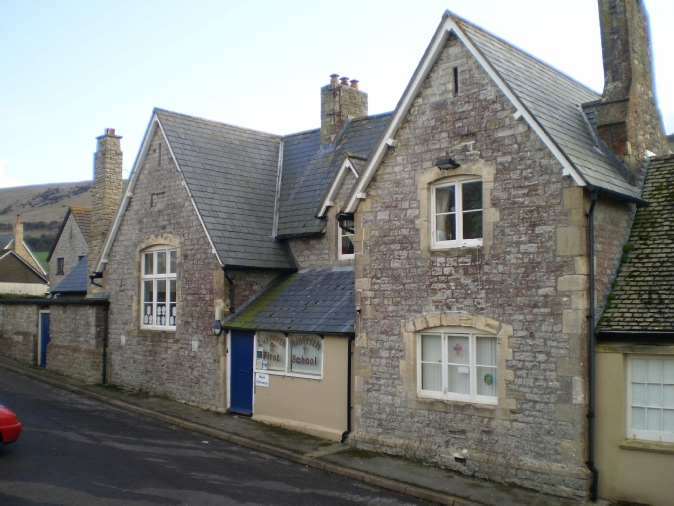
Schools in Rural England: Winfrith Newburgh
Winfrith’s timeline

Inside a small village on an arguably compact island, was a humble but bustling school. Whilst only a miniature building in nature, the bustling community and children who passed through it was truly telling towards the impact it had. Beginning in the 1860s, the school saw a numerous number of Mistresses and Headteachers until its ultimate collaboration with a neighbouring villages academic institution. To name a few, Miss Emma Eckett, who saw over the school for 43 years, and George Hollowood, a headteacher for 27 years. He was particularly praised for his outstanding feats in enabling extensions and mobile classrooms. The Winfrith first school officially closed down on the 31st of August 2007 and merged to become the now Lulworth and Winfrith CofE VC Primary School. Whilst the intricate details of the history are particularly difficult to come by, the rest of this website will paint the scenes for the bustling school life, the life of the employees, the changes throughout the years and just how much the school compares to those in its urban counterparts.
Winfrith School – A history through time
The rise and decline of Winfrith School
Winfrith School has been around for generations. Winfrith was once a thriving place, with over 90 students. However, it had to be closed due to the lack of students in 2007, having only 18 pupils in attendance. Prior to this in the 1960s, Winfrith School had three classrooms, an infant, middle and final year.
Why did this decline in students happen?
The decline in students at Winfrith School was due to a reduced population of families living in Winfrith, Newburgh and the decline of children, families in modern day society are having, due to changing societal norms.
The revival of Winfrith school: The 2007 Merger
In order to keep the school in operation, Winfrith Newburgh merged with West Lulworth school, which was in a neighbouring village.
However, not everything remained the same:
Winfrith Newburgh took on key stage one and early years provision and West Lulworth taught key stage 2.
This solution worked, allowing the amalgamated schools to thrive once more. Both communities are able to share their resources and remain in operation, sharing one Head Teacher.
How discipline in Winfrith School has changed through time
Punishments have changed in line with societal attitudes. In the 1960s schools had more formal environments and strict discipline. Corporal punishment was a method of disciplining students, whipping with canes to keep pupils in order and to make sure they followed the rules. This was both common and legal.
How do Winfrith School discipline their children currently?
Winfrith have a five-step behaviour policy in order to build clear consequences for the children’s challenging behaviour, which outlines their consequences. The most elevated consequences could involve visiting senior leadership and calling their parents, as a last resort the students may be excluded from school.
Teaching style: Talk and chalk to technology and creative classrooms
In the 1960s teachers used a ‘talk and chalk’ method to teach their students. This entailed children sitting at desks, in rows, facing the teacher. The teacher would use chalk on a blackboard.
How does this differ from learning environments today?
Today, Winfrith teaches with computers and white boards. Resources allow for online teaching and digital technologies. Outdoor spaces are available to allow more creative environments for a positive learning experience.
Winfrith aims to create an environment where ‘children are happy to share their ideas and thoughts knowing their ideas will be respected by others’.
Uniform changes through time in Winfrith School
Uniform has been significantly altered since the 1960s.
According to a former student Libby Smeaton children wore gingham skirts, red sashes and white shirts. This was a traditional, village schoolgirl style.
How has this style changed?
Village students now wear modern style clothing, using the school colours including red fleeces, white shirts, black school shoes and black trousers.
Changes to the curriculum over the years
In the 1960s there was no set curriculum, meaning schools had more freedom over what was taught. However, there was a limited subject choice and more emphasis on non-core skills, for example handwriting and reading.
How has this changed in Winfrith School
Due to the Education Reform Act 1988, schools must by law, follow a mandatory curriculum.
The curriculum involves subjects such as Phonics, Mathematics, Literacy, Science, History, Reading and writing
The Curriculum also offers subjects which were not formally recognised in the 1960s, such as Design and Technology, Geography and PSHE.
How did this shift in learning come about
This shift in education was due to wider social changes in post war, late 1960s, because schools were influential in responding to social and political change, such as equality and the Civil Rights Movement.

School life in Winfrith
The educational life of rural English children in the 1960s is an unexplored aspect of post-war Britain, and an oral history from Josephine Felgate, a member of the community in Winfrith from the 1960s to 2010, provides a look into village school life. Josephine recalled how community integration, discipline, and educational practises were core aspects of her school upbringing. The school functioned as the village’s social hub, a centre of contemporary education, and even a place of physical correction.
What did school life look like?
During this period, Winfrith School had roughly 100 students spread across three classrooms. This reflects typical rural village school life at the time, with a single teacher managing a classroom of kids of all ages. Due to the limited supply of teachers, the school leaving age was raised to 16 in the early 1970s, and the Education Act of 1944-47 required schools to have a high ratio of children to teachers. In Lulworth and Winfrith Primary School, these days, there is a ratio of approximately 14:1 to 17.9:1 of students to teachers, while according to Josephine Felgate, there would have been a ratio of 33.3:1.
What did the education of Winfrith look like?
This difference in teaching numbers meant that the teaching methods deployed were stricter classroom management and instructing larger groups of children at once. Examples described by Josephine Felgate include lining up the students in class before break, making sure they understood their spelling and mathematics, and administering physical punishment. Josephine Felgate described it as “In the youngest class, you’d get just a slap across the back of your legs. In the middle class, they used to give the ruler what? …And then in the seniors, the boys would get a pencil across their backsides.” Felgate reflected that “So you just knew stuff. You really knew solidly all the basics” which suggests that in her view, due to or despite the corporal punishment and resource constraints, the education which children in the 60s and 70s received was, in her view, effective.
The Unique Structure of Winfrith and Lulworth primary school
The main difference between Winfrith and other local primary schools is the split model across two villages with Reception and Key Stage 1 on the Winfrith site and Key Stage 2 pupils on the West Lulworth site. Compared to other local schools this seems strange as all others nearby operate on a single site. This requires some level of transition when attending this school which others may deem unnecessary in comparison to single site schools, however on the other hand it allows the school to remain small and personal allowing individual student needs to be met in a way which may not be as prevalent in other schools. This is reflected in the school’s ‘Good’ rating awarded by Ofsted, which indicates a strong-standard of teaching, leadership, behaviour and personal development. Comparatively this places it favourably amongst nearby schools.
What extracurricular activities were there to do?
Life in Winfrith was surrounded by arts and performances, such as what Jo describes, such as Cinderella, Robinson Crusoe, Snow White, and A Christmas Carol. Plays and activities like drama brought the village together socially. There were other forms of entertainment as well, such as the choir, which Jo’s grandmother took part in and played the organ for church services, as well as Jo’s mother, who performed in the choir. Youth sports teams that Jo took part in still exist today in the Winfrith area, such as sports day, football, and cricket, which can build relationships between schools and within schools.
Rural education in England in the 1960’s has transformed into an entirely different model by today. The three-classroom structure with high student-to-teacher ratios and corporal punishment was shaped by resource constraints and cultural attitudes towards children that don’t align with the values in a modern British society. Felagate’s testimony is that she thought it was effective, as the basic understanding of reading, writing, and mathematics was much clearer at the cost of the breadth of knowledge that kids are taught now. The school was closely integrated with community life, with events like sports and drama involving children in social activities. The social life of Winfrith today has been dramatically affected by motorisation, second homes, and supermarkets, crippling local businesses.
Comparisons to Winfrith from the ages
Winfrith’s character of rural education has endured many continuities in certain aspects, such as school size, community integration, its religious foundation, and the school’s values.
One of the most notable comparisons between the current Lulworth and Winfrith Primary School and the village school before is the number of students enrolled. Josephine recalled that her school had about “100 children from the village and the close villages.” And in the Ofsted report of 2017, we can see that there were 101 students, which was described as “smaller than average” This similarity reflects the stable population and capacity of these rural communities, and in mid-2024, the estimate of their population was 677 compared to their population in 1961, which was 626.
How did Winfrith differ to nearby schools?
Winfrith’s nature being a small, rural village is reflected in the structure and nature of its education. There is a lot of travel involved with even the primary school being split across two sites due to a merge between Winfrith and Lulworth’s schools due to the number of students being too small for both to feasibly run separately but allows a unique character which distinguishes it from other local schools.
Comparison with other primary schools in the area
In the area there are several other rural villages with primary schools just like Winfrith Newburgh and just like Winfrith and Lulworth they hold approximately 100-200 pupils, meaning they share similar class sizes and community-based environments. However, Ofsted inspections show some variation in the quality of education in the area:
- Lulworth and Winfrith CofE Primary School- good
- Bovington Academy- good
- Wool Church of England Primary School- good
- St Mary’s and St Joseph’s Catholic Primary School- Requires Improvement
- Frome Valley CofE First School- Requires Improvement
The fact that two nearby schools are rated ‘Requires Improvement’ suggests that the overall level of education in the area is mixed. In comparison, Winfrith and Lulworth’s ‘good’ rating places it above some neighbouring schools and indicates a stronger standard of provision. Although in general rural schools can be perceived as limited Winfrith and Lulworth demonstrates that village schools can achieve strong outcomes. Its inspection rating shows it performs better than some nearby alternatives, despite its small size and split-site arrangement. Small school sizes across the area allow for close staff and pupil relationships with strong support for each other.
Religious Character and Ethos of Local Schools
Religion plays a noticeable role in shaping school life in Winfrith Newburgh and surrounding villages. Lulworth and Winfrith Church of England Primary School has a clear Anglican foundation, which influences its ethos, assemblies and links with the local church while still welcoming pupils of all faiths and none. This Christian ideology is shared by other nearby schools including Wool and Frome Valley primary schools which reflect the historical role of the Church of England in rural primary school education in the UK. In contrast, St Mary’s and St Joseph’s Catholic Primary School follows a Roman Catholic ethos, with religious education and worship more closely aligned to Catholic doctrine. Bovington Academy, however, is a non-denominational school, meaning religion plays a less central role in daily school life compared to faith schools. Overall, Winfrith and Lulworth shares its Christian foundation with several local schools, the mix of CofE, Catholic and non-faith schools in the area provides families with a range of religious and culture approaches to education.
Secondary school choices
Because Winfrith Newburgh is a small village, all pupils must travel elsewhere for secondary education; often through bus travel. This is unavoidable and forms part of everyday life for families in the surrounding area, The Purbeck School is generally the most common destination for former Winfrith pupils moving on in their educational journeys. It is well established as a feeder school and benefits from familiarity and transport links as well as having a strong Ofsted rating of ‘good’. Other options include Beaminster School which secured a good Ofsted rating, and Budmouth Academy, which has a lower Ofsted rating of ‘requires improvement’, both of which require longer journeys. Budmouth Academy, located in Weymouth, offers a much larger school environment with wider facilities, contrasting sharply with the small primary experience pupils have in Winfrith.
How did village life affect school life?
Because village life was intertwined with school life, new technology affected how students interacted with one another. Josephine Felgate identified that an increase in car ownership had changed the social aspects of students and calls it “the biggest change”. Before, families would walk to the shops together and bump into each other, making social interactions a regular occurrence inside Winfrith. By 2010, families would drive to supermarkets, and second homes became more common, meaning that students would interact with each other outside of school less in person. On the other hand, Josephine concedes that socialising outside the village became a lot easier with newer technology and transport. Second homes in the area have been increasing, as seen by Purbeck District Council, which reported a 6.5% increase to 6.68%, and a census report from 2001 to 2011 saw housing stock rise from 7.3%, but population increased by only 1.3%. The effect of this on young people means that they leave the area of Winfrith as they are being priced out of homes, which brings the social cohesion of the village down.
Work life in Winfrith School.

Working at Winfrith’s National school was viewed as a joyous occasion by some. Whilst not a teacher, Joyce Catchpole adored the community and atmosphere around the school and saw her colleagues in nothing but a positive light. Furthermore, she liked to reminisce about how lovely she found all of the children. This proves how proud teachers were to do their job and how rewarding it could be. One key to a positive learning and teaching experience are the vibes surrounding the environment, so it is wonderful to know first hand how motivating of an institution it was.
But what about the curriculum?
Looking specifically at the teaching methods and curriculum of the school, it was heavily centred around educating children from more unfortunate backgrounds such as labouring or being poor. However, the school was still open to all local children during the 1860s. The curriculum followed the same structure as its surrounding National schools which focused on reading, writing and arithmetic. Within this there was also religious instruction implemented to enable them to follow the specific standards set. Typically, these education systems would be guided by a headteacher and an assistant – similar to most schools now. In addition, there were typically lessons surrounding manual labour such as woodwork or sewing to help with pupils’ futures.
What were the daily responsibilities?
Unlike now where teachers have specific key stages to teach, the classes were unusually large and often had children of varying ages within these classes. As a teacher, the role wasn’t solely to educate the children, it was also to maintain discipline. Some of the ways to discipline the children during the early development of the school is now frowned upon and has alternative, contemporary methods now. As a teacher, it was incredibly unlikely for parents to question the punishments incorporated into daily school life. In fact, the stricter the discipline, the higher your competence was viewed. Additionally, there are many records to prove the job of keeping attendance registers and other notes such as inspections. The pay was much lower in relation to current wages, and another key difference was the fact that they were typically expected to work an extra half day during the week for teaching and the lessons would run from morning to late afternoon.
What was life like outside of their job?
As a teacher, their role outside of education was similar to that in education. Whilst they didn’t need to take the role of disciplining children outside of education, they had to worry about their own image. By living close to the schools, it meant they also usually knew the families of their pupils personally. As a result of this, the reputation of teachers mattered greatly to themselves and other, so they were expected to behave accordingly. It was common practice that teachers needed to be good role models for their students.
Classrooms and Religion?
As a teacher, for a while, resources for learning were limited. Therefore, teaching materials were difficult to come by and creativity was limited due to the large class sizes. As a result of this, they heavily relied on things such as repetition. Since it was, and still is, a Church of England school, teachers were expected to integrate religion into their teaching schedules. This included Bible lessons and prayers. Mandatory church attendance was implemented; this was easy to do due to the small scaled of the village. National schools would be inspected and judged not only on their academic feats but also their moral influence and discipline.
Winfrith as a whole

Winfrith School has developed and overcome challenges to become the thriving school it is today, with a strong standard of teaching and leadership, keeping some of its best qualities from the past. This has allowed Winfrith to remain in line with changing societal attitudes and with the curriculum, to give students the best learning opportunities and the perfect balance of being strict and enjoyment for the students. Winfrith has kept their religious influences and values to give their students the positive experience they expect, keeping their unique rural nature in the structure of the school. However, Winfrith has faced challenges with changing societal norms, which they overcame through merging with Lulworth, allowing a small, personal atmosphere for the students. In comparison to other schools in the area, Winfrith has ranked favourably, such as St Mary’s and St Joseph’s Catholic Primary School and Frome Valley CofE First School, despite its small size and necessary travel. Working in Winfrith is a joyous and accomplishing task, due to the positive atmosphere.
Bibliography
“Brief History of Schools in West Lulworth – West Lulworth & Lulworth Cove.” 2022. West Lulworth & Lulworth Cove. October 5, 2022. https://westlulworth.org.uk/schools-history/.
Chris Pullen A Short History of Winfrith Newburgh 2025
City Population, Winfrith Newburgh, (2021). https://www.citypopulation.de/en/uk/southwestengland/admin/E06000059__dorset/
District Council, Purbeck. 2018. “Second Homes Evidence Paper.” https://www.publichealthdorset.org.uk/documents/35024/283824/second-homes-evidence-paper.pdf/1b6438…
Education UK. “Primary Education in the Late 1950s and Early 1960s.” https://education-uk.org/history/
Edward Chynoweth-Smith, interview with Josephine Felgate, (November 2025).
“Frome Valley CofE First School – GOV.UK.” 2024. Service.gov.uk. 2024. https://get-information-schools.service.gov.uk/Establishments/Establishment/Details/141777.
Gale, Stuart, and David Edward. 2017. “Lulworth and Winfrith CofE vc Primary School Report Ofsted.” Ofsted. 2017. https://files.ofsted.gov.uk/v1/file/2693211.
Gov.uk, History programmes of study: key stages 1 and 2. (2013). https://assets.publishing.service.gov.uk/media/5a7c2917e5274a1f5cc762cf/PRIMARY_national_curriculum_-_History.pdf
Grace, Gerald. “Changes in the classification and framing of education in Britain, 1950s to 2000s: an interpretive essay after Bernstein.” Journal of Educational Administration and History 40, no. 3 (2008). https://www.tandfonline.com/doi/full/10.1080/00220620802507193
Historic UK, Schooldays in the 1950s and 1960s, (2015). https://www.historic-uk.com/CultureUK/Schooldays-in-the-1950s-1960s/
“History | Winfrith Newburgh.” 2016. Winfrith Newburgh . 2016. https://www.winfrithnewburgh.org.uk/history.
Lillie Wainwright, Interview with Joyce Catchpole (October 2025)
Locrating.com. 2025. “Winfrith Newburgh.” Locrating. 2025. https://www.locrating.com/the-best-Primary-schools-in-Winfrith%20Newburgh_Dorset_England.aspx.
Lulworth & Winfrith CofE Primary School.
https://www.lulworthwinfrith.dorset.sch.uk
“Lulworth and Winfrith CofE vc Primary School – GOV.UK.” 2023. Service.gov.uk. 2023. https://get-information-schools.service.gov.uk/Establishments/Establishment/Details/135323
Ofsted, Lulworth and Winfrith CofE VC Primary School, 2017. https://www.lulworthwinfrith.dorset.sch.uk/
“PE and Sport Premium | Lulworth and Winfrith CofE Primary School.” 2024. Dorset.sch.uk. Lulworth and Winfrith CofE Primary School. 2024. https://www.lulworthwinfrith.dorset.sch.uk/pe-and-sport-premium/.
Roberts, Sam. Interview with Libby Smeaton, (August 2025).
“St Mary & St Joseph’s Catholic Primary School – GOV.UK.” 2024. Service.gov.uk. 2024. https://get-information-schools.service.gov.uk/Establishments/Establishment/Details/140770.
Tracy Miller and Braun, “Education reform act.” 1988. (October 2011). https://millertracy.com/sites/default/files/October%202011%20Newsletter.pdf
“Wool Church of England Primary School – GOV.UK.” 2024. Service.gov.uk. 2024. https://get-information-schools.service.gov.uk/Establishments/Establishment/Details/148328.