
The First Indians in Bournemouth: First World War Indian Army Soldiers and the No. 8A Indian General Hospital
by Hamza Kreik, Nathan Davies and Matt Beach
Forgotten or unrepresented?
The contributions of the Indian Soldiers for the British Army during World War One have often been swept under the rug or forgotten entirely. The Cenotaph, Bournemouth War Memorial, built in 1921, originally had no mention of the Indian soldiers, but after hard work from the BPC Indian Community, the council and local historian Nick Saunders, two bronze plaques were unveiled to remember the tweleve Indian soldiers that sadly passed away in Bournemouth.
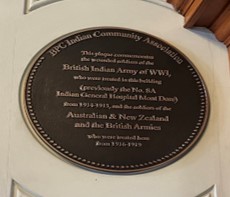
In recent years there has been excellent work to truly represent the history of Indian Soldiers in Bournemouth. For example, the plaque that commemorates the soldiers in the reception of the Town Hall. By uncovering the journeys and stories of those soldiers who were treated in Bournemouth, and the effects they had on the people of the town, our project seeks to add to the great work already started by the BPC Indian Community by shining a light on their brave sacrifice.
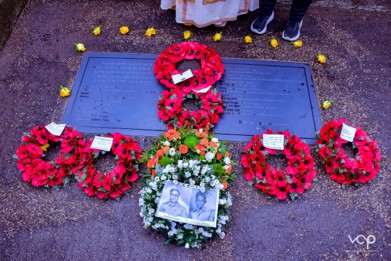
Photo of bronze plaque remembering the twelve Indian Soldiers who passed away at the No.8A Indian General Hospital.
Photo courtesy of the BPC Indian Community.
Indian soldiers’ journey to Europe
When Britain declared war on Germany, the Viceroy of India immediately pledged support. Around 45,000 men from the India Expeditionary Force A were mobilized and set sail from ports such as Karachi and Bombay. These soldiers would arrive most commonly in Marseille, where, during the First World War, a total of over 1.3 million Indian soldiers volunteered to fight on the British side. It is estimated that more than 70,000 soldiers lost their lives for the Allied victory 1
By October 1914, just weeks after arriving, they were thrown into the First Battle of Ypres. According to one British officer, ‘they filled a gap in the line when we had no other troops to put in’.2 The Indian soldiers made altering contributions to the war, fighting in many battles including Ypres and Neuve Chapelle. The Battle of Neuve Chapelle alone brought ‘160 Indians’ to the town.3
They came from modern-day India, Pakistan, and Bangladesh. They were Gurkhas, Sikhs, Muslims, and Hindus.
Indian soldiers’ arrival in England
Tens of thousands of Indian Soldiers served on the Western Front in the First World War, and at one point the soldiers made up a third of the British Army on the Western Front.
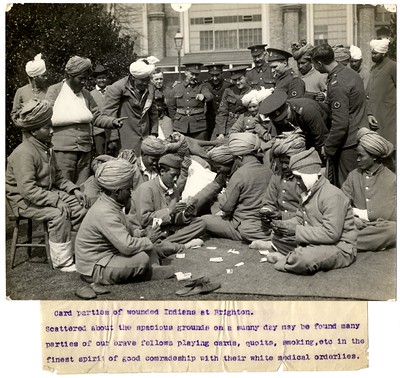
With the medical facilities in France becoming overwhelmed due to the increasing numbers in casualties, it was decided that some of the Indian soldiers would be transported to England to receive treatment. This allowed England to provide specialized care, that could be adapted to meet the dietary and religious needs of the soldiers. The soldiers arrived in Southampton, and then were sent to Brighton, the New Forest, and Bournemouth.
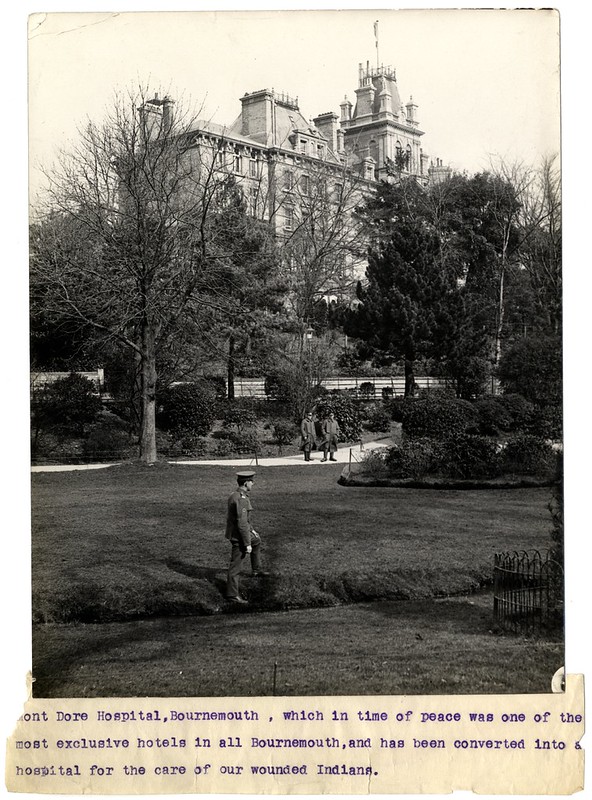
In Brighton there were multiple sites used, however the Royal Pavillion is the most recognized of them all. In the New Forest, the Lady Hardinge Hospital treated around 3,000 wounded Indian soldiers. In Bournemouth, the most forgotten of the three, the Mont Dore Hotel was transformed into a hospital in two days and treated over 1,000 wounded Indian soldiers.
Decision to come to Bournemouth
King George V visited the Indian soldiers in November 1914 and inspected their living situation, which was tattered tarp and shabby tent stations, levaing the soldiers bare to the elements and less sanitary than it should be.
King George V made the decision that the Mont Dore Hotel in Bournemouth was to be requestioned and opened as the No. 8A Indian General Hospital.
This was significant because Bournemouth was now one of the only three locations in the entire UK dedicated to treating and rehabilitating Indian soldiers
Over 1000 troops from the British Indian army were sent to and treated at the location
Transition from the Mont Dore Hotel to the No. 8A Indian General Hospital
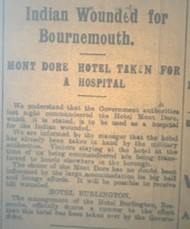
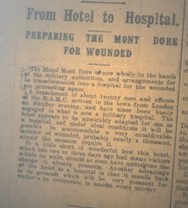
The government authorities commandeered the Hotel Mont Dore, for the use of treating Indian Soldiers who had been wounded on the Wester Front. People staying at the hotel were transferred to other nearby hotels. The Bournemouth Graphic reported on 27 November 1914 that the guests ‘fully appreciated the circumstances, and rendered all possible assistance in the Matter’.4
Twenty officers and men of the Royal Army Medical Corps (R.A.M.C) were assigned to the hospital. Thirty to forty soldiers of the Madras Infantry Regiment were to look after the wounded.5 After being taken over on 20 November 1914, it took in its first patients on 22 November 1914.
Hospital life
At the No. 8A Indian General hospital the wounded soldiers were afflicted with terrible injuries. The most common were trench related injuries – trench foot, filthy conditions which caused rampant infection, countless amputees due to gangrene, rats in the trenches furthering pushing disease. Other injuries included shrapnel and bullet wounds as well as gas poisoning and severe PTSD.
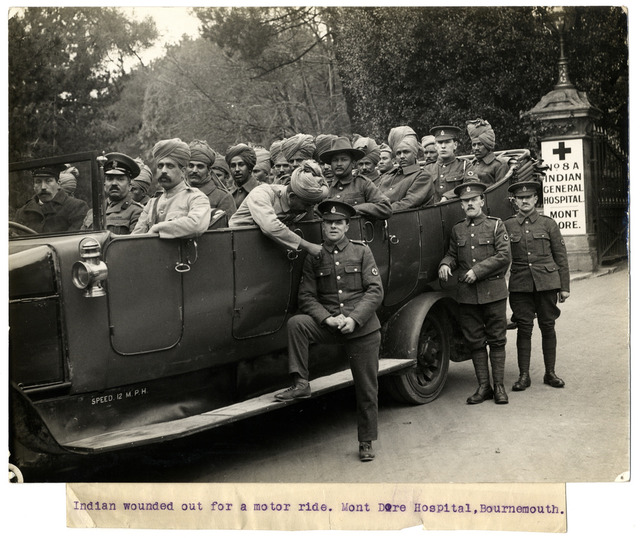
The hospital provided the soldiers with relief and was essentially a sanctuary compared to the French trenches and the previous shabby tarps and medical stations. Concerts were arranged to boost morale as well as provide a form of entertainment which included Indian music as well as religious talks.6 Some of the Indian troops, when the Mont Dore was an Indian Hospital, were transferred by charabanc.7
Treatment of Indians at the hospital
The setting of Bournemouth was a decisive factor in the hospital’s treatments. The doctors believed that the soldiers would find comfort and heal in Bournemouth seaside and forest settings which was believed to contain medicinal and emotional healing properties.
The facility worked under War Office Supervision, and they were given the options to partake in numerous physical activities as well as engage with their British counterparts in social events. While the treatment was reported as being just and kind, the food had a mixed rating, with some soldiers not minding it or even favouring it, while others did not share those sentiments.8
Treatment of Indians by the public
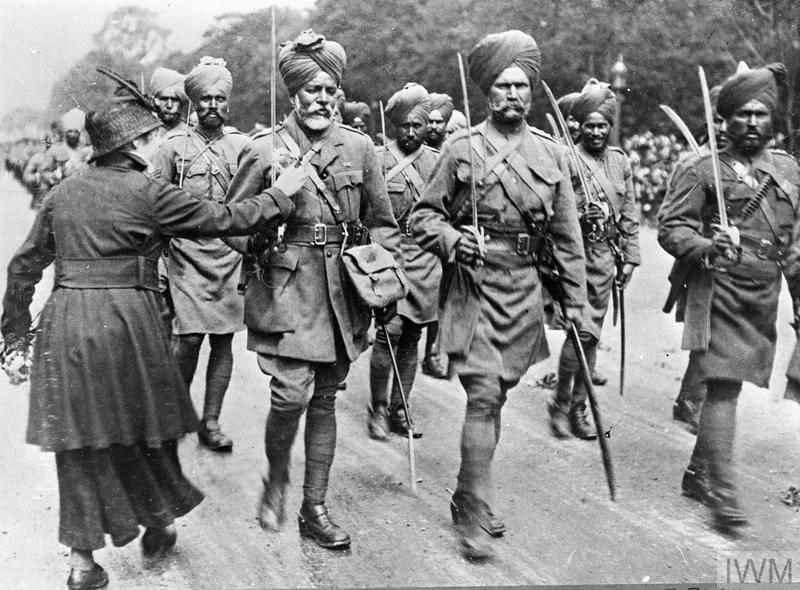
While being treated and recuperating at the No. 8A Indian General Hospital, the soldiers mixed with the town and integrated well with the locals. They would often shake hands, and onlooking children would follow suit to show their good-will. Soldiers were escorted around by a British officer when leaving hospital premises and taken around town for a vehicle tour for activities such as walks on the beach and through the forests, walking around town getting to know the area, and boat trips.
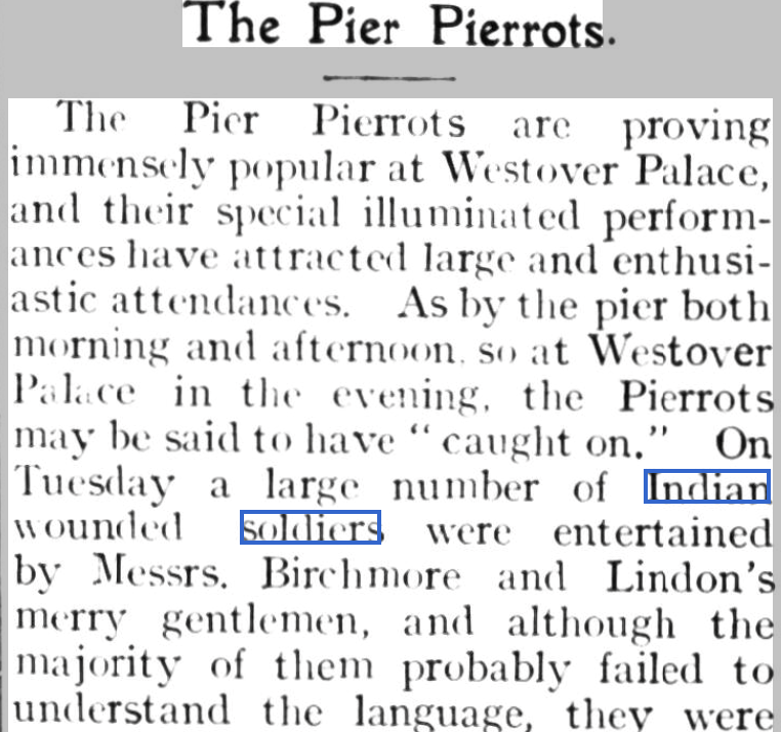
Cricket and football matches were played with the locals.9 People in Bournemouth loved to see the Indian soldiers and would turn up with the opportunity to see them. The Bournemouth Graphic reported that ‘in spite of the inclement weather that prevailed on Monday, crowds of people left Bournemouth to witness the combined sports for Indian troops at Barton-on Sea’.10
Treatment of Indian soldiers by the public
The local women also took interest in the soldiers often trying to see them and sneak in gifts and treats such as chocolate and cigarettes. In return for the gifted cigarettes, the Indian soldiers would produce their Eastern cigarettes and give them to members of the greeting crowd.
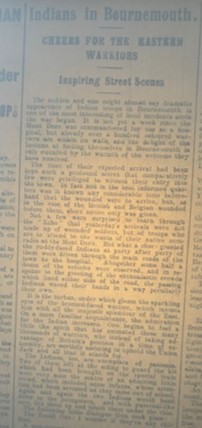
The Times said on 8 January 1915 that ‘the whole impression is that people are going on just the same’.11 The Bournemouth Daily Echo said, ‘what a cheer greeted the ruddy-faced Indians as party after party of them were driven through the main roads of the town to the hospital’.
The people of Bournemouth were thrilled to have the Indian soldiers with them and enjoyed spending time waiting to greet them as they headed towards recovery. The Indian soldiers ‘waved their hands in a way peculiarly their own’. The public were fascinated with the constant arrival of Indian soldiers. In the Bournemouth Daily Echo, it shared an interaction between two soldiers and a small child. The child asked, ‘I wonder if they’ve any children’, to which one soldier replied, ‘Childrens, yes, childrens. I have four, and (pointing to comrade) him three’.
Religious diversity
Even though the Indian troops were from the same undivided country, there were differences between the troops. In the hospital there were Muslims, Sikhs, and Hindus. The reason this is significant is because all these religions have diverse ways of life.
The distinctions between the soldiers:
•Sikhs consume a mostly vegetarian diet with a select few eating meat. However, they are banned from eating Halal and Kosher meat;
•Muslims can only consume halal meat and are strictly forbidden from eating pork;
•Hindus do not eat beef for the most part, and many are vegetarians particularly among the higher caste members.
How the newspapers reported on the soldiers
Like the public, the newspapers were full of excitement at the arrival of the Indian soldiers and remained that way until they left Bournemouth. In The Bournemouth Daily Echo on 26 November 1914, it said, ‘the admiration for the Indian increases. One begins to feel a little the spirit that has animated these many thousands of warriors, who instead of taking advantage of Britain’s position in a time of extremity, are worthily assisting to uphold the Union Jack and all that it stands for’.
… there are still between 1,000 and 2,000 in Bournemouth, “shall it be any longer?”
One of the lasting impressions was the sacrifice they made. The public recognised that they were leaving their families to serve in a war, alongside a country they had never been to. It was said in the Bournemouth Daily Echo that ‘there are still between 1,000 and 2,000 in Bournemouth, “shall it be any longer?” asked one in the crowd, whose duty it is to serve his country in the all important duty of recruiting.’ People were frustrated that the Indian men from over 4,500 miles away from France were fighting a war that men across the channel were not volunteering for.
It was reported on 26 November 1915 in The Bournemouth Graphic that, ‘all our gallant Indians have now left the town. Alas, another loss in local “colour”!’
Where did the soldiers go after they recovered?
After the Indian soldiers recovered, the soldiers were assessed for their fitness and ability to be returned to war. Soldiers that were well enough to fight were sent back to the Western Front.
The soldiers that were not well enough to return to the front line were sent back to India, where they recovered further. In some cases, soldiers recovered and adjusted to life with their injuries. Injuries that led to them returning to India included the loss of limbs, fingers, impairment or loss of vison, and in some cases, bayonet wounds that pierced through hands and caused severe damage. The number of patients admitted to the No. 8A Indian General Hospital is not known, however the hospital is estimated to have looked after over 1,000 Indian soldiers.12
Where did the Indian soldiers go when the hospital was reassigned to South African soldiers?
The No. 8A Indian Gerneral Hospital transitioned in November 1915 when the Indian Army Corps withdrew from France.13 When the Hospital was reallocated, the Indian soldiers were transferred to other locations. They were moved to the Pavillion Hospital at Brighton, to Lady Hardinge’s Hospital at Brockenhurst, and the convalescent depot at Barton-on-Sea.14
The Mid-Sussex Times reported that on 9 November 1915 ‘266 wounded Indian warriors arrived by train from Bournemouth. Systematised though it is, the arrival of wounded remains a sad, sad sight’. The report suggests that the process of preparing the No.8A Indian General Hospital for its new patients started just over two weeks before the last patients had left, however it may have been sooner.
What is the hospital today?
Following the conclusion of the war, Bournemouth Borough Council bought the Mont Dore building. It reopened in 1921 as the Town Hall, and it was decided that the civic offices would be moved into the building.15 Main works included the removal of hospital wards and military medical facilities. Furthermore, bedrooms and recovery spaces were turned into council offices and administrative rooms.
Ghost encounters of solders and nurses
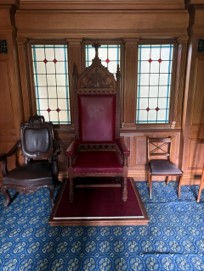
The Headless Maharajah
Rumoured to walk the forth floor, headless, and dressed in ceremonial Indian uniform. He is said to sit upon in a chair and moan. This chair is now located outside the council chamber and is made from a costly Indian Teak from Burma. Sitting in this chair is considered the closest the ghost can get to going home.16
The Nurse
Former Council employee Elizabeth recalls hearing stories of a First World War nurse, who walks through the basement in her starched uniform. Formerly she was seen in the filing rooms under the Grand Hall. These rooms were initially Turkish Baths but were used as a morgue when the building was used as a hospital. Since the extension was built and the morgue replaced by a car park, she has been reported walking through the car park walls.17
The Indian Soldier(s)
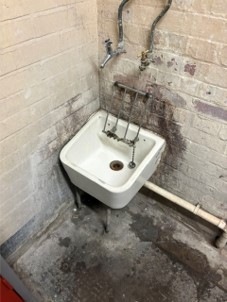
Former Publicity officer Dick wrote about the First World War Indian soldier who haunted the old baths. Supposedly, the soldier is said to travel from the site of the morgue to the other end of the corridor to help himself to a drink of water at an old sink, and to wash the bandages on his head. The soldier has been reported by people who claim they hear marching behind them in the corridor. In some versions of this story, the soldier is a Gurkha; in others a turbaned Sikh with a poorly tied bandage, walking with a crutch.18
Remembering the fallen soldiers – The ‘Bournemouth Twelve’
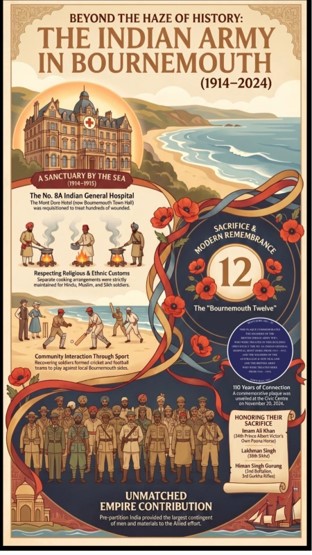
This image was created by Andy Saunders of Omnisector Ltd, a local supporter, and provided to us by Ramesh Lal. It shows a quick history on the hospital, the treatment of the soldiers, the activities they took part in, and the contribution the Indian soldiers made during the First World War. Finally, is has a section remembering the soldiers that unfortunately succumbed to their injuries and passed away.
Budha – Driver 1439, Bharatpur (Imperial Service) Transport Corps
Gurung, Himan Sing – Rifleman 1763, 2nd Battalion, 3rd Queen Alexandra’s Own Gurkha Rifle
Khan, Imam Ali – Daffadar 2685 Prince Albert Victor’s Own Poona Horse
Khan, Mehr – Sowar 2587, 19th Lancers (Fane’s Horse)
Negi, Har Sing – Rifleman 2104, 1st Battalion, 39th Garhwal Rifles
Pun, Gajle – Rifleman 2214
Ram, Santa – Follower, 6th King Edward’s Own Cavalry
Singh, Bishn – Daffadar 1574, 2nd Lancers (Gardner’s Horse)
Singh, Kesar – Sepoy 1410, 19th Punjabis
Singh, Lachman – Lance Naik 2563, 36th Sikhs
Singh, Munsha – Sepoy 3954, 29th Punjabis
Thapa, Dilmani – Rifleman 3718, 1st Battalion, 4th Gurkha Rifles
After searching through war diaries from Hampshire and Brighton, we were unable to add to the list of known soldiers that recouperated in Bournemouth. Unfortunately, Bournemouth did not document the soldiers’ presence, and it is something that is not only unusual, but rather rare for war time Britian.
These twelve men that perished are known, and they represent over 1.3 million Indian soldiers that served during the First World War. They showed bravery and the sacrifices these soldiers made deserve to be remembered, honoured, and celebrated.
Why we chose this topic
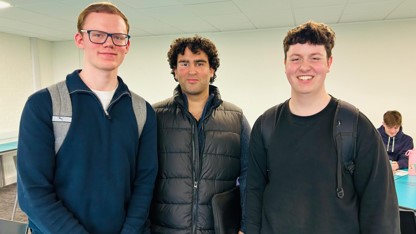
When we were presented with the topic in December 2025, we as a group conducted extensive research on the first Indian soldiers in Bournemouth and concluded that there was an unfathomable lack of documentation of their stories and sacrifices
Following this, we set out to curate an online exhibition detailing their journeys and accurately representing the contributions of the Indian Soldiers to the British war effort in the First World War.
Help from the BPC Indian Community
The Bournemouth Poole and Christchurch Indian Community is an organisation which aims to unite communities through Indian culture, and has done so through organising events and supporting other community memebers.
The BPC Indian Community commemorates and conserves the actions and history of the Indian people in Bournemouth, Poole, and Christchurch locations. The organisation has sought recognition of the Indian soldiers who are considered the first Indians in Bournemouth, by participating in commemorative events, studies and research such as unveiling plaques of remembrance.
We received help from the BPC Indian Community through Ramesh Lal who has worked with local councils as well as provided us a whole network of people such as Jeff Brown at the town hall, as well as local historian Nick Saunders.
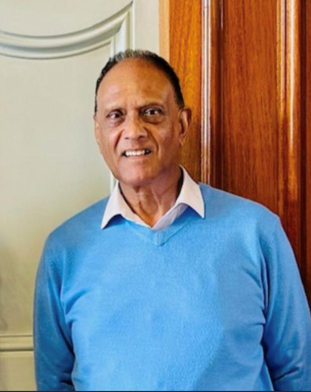
Ramesh Lal, Community Lead, BPC Indian Community, at the unveiling of a plaque commemorating the No. 8A Indian General Hospital at Bournemouth Town Hall
Heritage preservation
The BPC Indian Community has worked diligently to ensure that the sacrifices of all the Indian soldiers are commemorated appropriately. On 20 November 2024, a plaque was placed in the entrance of the Town Hall, proudly displaying the heritage of the building as well as informing visitors of its history. Ramesh was vital in ensuring appropriate heritage recognition.
This project forms part of the new wave of heritage preservation of this forgotten history in Bournemouth. We hope that this exhibition can be used to educate and bring awareness to the history that the BPC Indian Community is striving to preserve and to ensure as many people as possible in Bournemouth are aware and acknowledge the crucial contributions of Indian soldiers in the First World War.
What the BPC Indian Community are currently working on
The BPC Indian Community is currently working on a new project that aims to raise awareness of the first Indians in Bournemouth via the First World War Indian Army Soldiers. The BPC Indian Community is passionate that this history should not be forgotten. Before the BPC Indian Community started to uncover more of the history of the No. 8A Indian General Hospital in Bournemouth, there were very few modern-day reports on the topic, and since their work, it has been reported in the news and by local historical websites, becoming a more researched area of local and national history in the two years after the BPC Indian Community unveiled a plaque commemorating the former hospital, which is free to visit inside the Bournemouth Town Hall.
Resources
Bournemouth Graphic. 6 August 1915.
Bournemouth Town Hall – A Brief History. Bournemouth Library Heritage, 2018.
Edgington, M A. Bournemouth and the First World War. Bournemouth: Bournemouth Local Studies Publications, 1985.
From Hotel to Hospital – Preparing The Mont Dore For Wounded. Bournemouth Daily Echo. 23 November 1914.
Indians in Bournemouth – Cheers For The Eastern Warriors – Inspiring Street Scenes. Bournemouth Daily Echo. 26 November 1914.
‘Indian Memorial in Barton on Sea’. Milton Heritage Society. July 2020. 15 May 2026. https://miltonheritagesociety.co.uk/chapters/milton-in-the-wars/indian-memorial-in-barton-on-sea/.
Indian Wounded – Arrivals And Departures At Bournemouth – Ambulance Train From Netley. Bournemouth Daily Echo. 30 November 1914.
Indian Wounded for Bournemouth – Mont Dore Hotel Taken For A Hospital. Bournemouth Daily Echo. 20 November 1914.
Sophia Seth & Marcus White. “The seaside sanctuary for inured WWI Indian soldiers”. BBC News. 21 November 2025. 3 May 2026. https://www.bbc.co.uk/news/articles/c1dp26lg11ro.
Stead, Michael. Le Mort Dore – The Ghosts of Bournemouth Town Hall. 2004.
The Pier Pierrots. Bournemouth Graphic. 11 June 1915.
Tom Hayes. “Remembering the Indian Army in Bournemouth”. Tom Hayes MP. 29 October 2025. 3 May 2026. https://tomhayes.org.uk/resources/the-future-of-public-libraries-2/
Footnotes
- Tom Hayes, “Remembering the Indian Army in Bournemouth,” Tom Hayes MP, 29 October 2025, 3 May 2026, https://tomhayes.org.uk/resources/the-future-of-public-libraries-2/. ↩︎
- Sophia Seth & Marcus White, “The seaside sanctuary for injured WWI Indian soldiers,” BBC News, 21 November 2024, 3 May 2026, https://www.bbc.co.uk/news/articles/c1dp26lg11ro. ↩︎
- M A Edgington, Bournemouth and the First World War (Bournemouth: Bournemouth Local Studies Publications, 1985), p.14. ↩︎
- M A Edgington, Bournemouth and the First World War (Bournemouth: Bournemouth Local Studies Publications, 1985), p.6 ↩︎
- Bournemouth Town Hall – A Brief History, (Bournemouth Library Heritage, 2018), p.4 ↩︎
- “Indian Memorial in Barton on Sea,” Milton Heritage Society, July 2020, 15 May 2026, https://miltonheritagesociety.co.uk/chapters/milton-in-the-wars/indian-memorial-in-barton-on-sea/. ↩︎
- Bournemouth Town Hall – A Brief History, (Bournemouth Library Heritage, 2018), p.5 ↩︎
- Sophia Seth & Marcus White, “The seaside sanctuary for injured WWI Indian soldiers,” BBC News, 21 November 2024, 3 May 2026, https://www.bbc.co.uk/news/articles/c1dp26lg11ro. ↩︎
- Sophia Seth & Marcus White, “The seaside sanctuary for injured WWI Indian soldiers,” BBC News, 21 November 2024, 3 May 2026, https://www.bbc.co.uk/news/articles/c1dp26lg11ro. ↩︎
- Bournemouth Graphic, 6 August 1915. ↩︎
- M A Edgington, Bournemouth and the First World War (Bournemouth: Bournemouth Local Studies Publications, 1985), p.12. ↩︎
- M A Edgington, Bournemouth and the First World War (Bournemouth: Bournemouth Local Studies Publications, 1985), p.68. ↩︎
- Bournemouth Town Hall – A Brief History, (Bournemouth Library Heritage, 2018), p.4. ↩︎
- M A Edgington, Bournemouth and the First World War (Bournemouth: Bournemouth Local Studies Publications, 1985), p.23. ↩︎
- Bournemouth Town Hall – A Brief History, (Bournemouth Library Heritage, 2018), p.7. ↩︎
- Michael Stead, Le Mort Dore – The Ghosts of Bournemouth Town Hall, (2004), p.7. ↩︎
- Michael Stead, Le Mort Dore – The Ghosts of Bournemouth Town Hall, (2004), p.3. ↩︎
- Michael Stead, Le Mort Dore – The Ghosts of Bournemouth Town Hall, (2004), p.3. ↩︎